Note
This page renders committed notebook outputs. The Read the Docs build does not execute notebook code.
Multi-generator diagnostics without overclaiming#
Current surface: V0.29.
Purpose#
Show the V0.27 multi-generator diagnostic surface: supplied GeneratorFamily objects, span/rank/closure diagnostics, candidate validation behavior, and a clear public-promotion decision.
What you will learn#
How algebraic diagnostics differ from PDE-context validation.
How closed, non-closed, and rank-deficient families are reported.
Why closure does not imply residual symmetry.
Why public multi-generator fitting, finite flows, BCH composition, and orbit charts remain deferred.
Required extras#
Core install is enough; Matplotlib is used for tutorial status plots.
Expected runtime#
Less than 1 minute.
Out of scope#
No public multi-generator fitting API, no finite multi-generator group action, no BCH composition, no multi-parameter orbit atlas, no learned symmetry-group training.
[1]:
from pathlib import Path
import sys

ROOT = Path.cwd()
if not (ROOT / "pyproject.toml").exists():
    ROOT = ROOT.parent
if str(ROOT) not in sys.path:
    sys.path.insert(0, str(ROOT))

from notebooks._tutorial_utils import plot_label_strip, plot_named_metrics, pretty_json
from pdelie.examples import run_multi_generator_diagnostics_example

CONFIG = {"show_full_closure_reports": False}
CONFIG
[1]:
{'show_full_closure_reports': False}
1. Run the public diagnostic example#
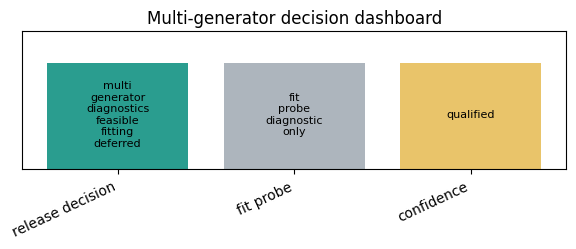
The example uses supplied generator families only. It does not fit a multi-generator family from PDE data.
[2]:
example = run_multi_generator_diagnostics_example()
plot_label_strip(
    {
        "release decision": example["decision"]["conclusion"],
        "fit probe": example["fit_probe_diagnostics"]["label"],
        "confidence": example["confidence"]["confidence_label"],
    },
    title="Multi-generator decision dashboard",
)
print(pretty_json(example["decision"], max_chars=2500))
{
  "conclusion": "multi_generator_diagnostics_feasible_fitting_deferred",
  "public_promotion_decision": "no_public_multi_generator_fitting_or_invariant_action",
  "release": "v0.27.0"
}
2. Algebraic diagnostics are their own lane#
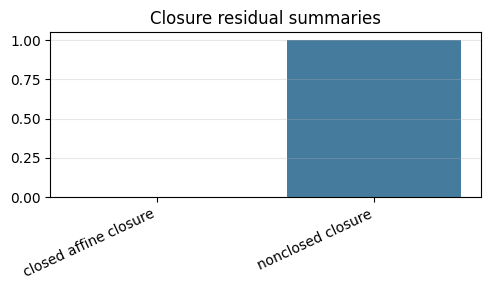
A closed affine family, a non-closed polynomial family, and a rank-deficient family produce different diagnostics. None of these statements, by itself, says the PDE residual is preserved.
[3]:
algebra = example["algebraic_diagnostics"]
metrics = {
    "closed affine closure": algebra["closed_affine_x"]["closure"]["summary"],
    "nonclosed closure": algebra["nonclosed_polynomial"]["closure"]["summary"],
}
plot_named_metrics(metrics, title="Closure residual summaries")
print(pretty_json({
    "closed_affine": {
        "rank": algebra["closed_affine_x"]["family_rank_status"],
        "bracket_convention": algebra["closed_affine_x"]["bracket_convention"],
        "structure_constant_error": algebra["closed_affine_x"]["structure_constants"]["structure_constant_error"],
    },
    "nonclosed_polynomial": {
        "rank": algebra["nonclosed_polynomial"]["family_rank_status"],
        "closure_summary": algebra["nonclosed_polynomial"]["closure"]["summary"],
    },
    "rank_deficient": {
        "rank": algebra["rank_deficient_affine"]["family_rank_status"],
        "structure_constant_status": algebra["rank_deficient_affine"]["structure_constants"]["status"],
        "span_comparison_status": algebra["rank_deficient_span_comparison"]["comparison_status"],
    },
}, max_chars=4500))
{
  "closed_affine": {
    "bracket_convention": "[X_i, X_j] = X_i \u00b7 \u2207X_j - X_j \u00b7 \u2207X_i",
    "rank": "full_rank",
    "structure_constant_error": 0.0
  },
  "nonclosed_polynomial": {
    "closure_summary": 0.9999999999991339,
    "rank": "full_rank"
  },
  "rank_deficient": {
    "rank": "rank_deficient",
    "span_comparison_status": "warning",
    "structure_constant_status": "unavailable"
  }
}
3. PDE-context validation is a separate lane#
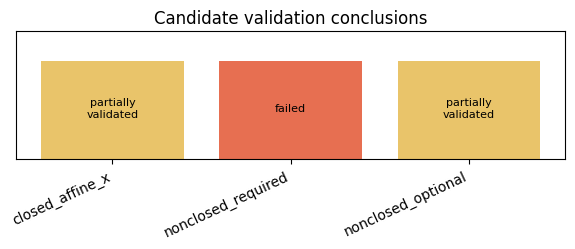
Candidate validation can report closure evidence, span evidence, and configured residual/finite-transform checks. In V0.29, multi-row families with only algebraic evidence conclude at most partially_validated.
[4]:
pde_context = example["pde_context_diagnostics"]
plot_label_strip(
    {name: report["conclusion"] for name, report in pde_context.items()},
    title="Candidate validation conclusions",
)
print(pretty_json({
    name: {
        "candidate_kind": report["candidate_kind"],
        "conclusion": report["conclusion"],
        "source_candidate_id": report["source_candidate_id"],
    }
    for name, report in pde_context.items()
}, max_chars=4500))
{
  "closed_affine_x": {
    "candidate_kind": "generator_family",
    "conclusion": "partially_validated",
    "source_candidate_id": "example_affine_x_closed_supplied_family"
  },
  "nonclosed_optional": {
    "candidate_kind": "generator_family",
    "conclusion": "partially_validated",
    "source_candidate_id": "example_nonclosed_optional"
  },
  "nonclosed_required": {
    "candidate_kind": "generator_family",
    "conclusion": "failed",
    "source_candidate_id": "example_nonclosed_required"
  }
}
4. The boundary is the feature#
The report is designed to be useful to external or learned methods that can supply candidate generator families. PDELie diagnoses those families; it does not claim to learn multi-generator groups or construct finite augmentation orbits.
[5]:
print(pretty_json({
    "generator_source": example["extra_metrics"]["generator_source"],
    "closure_does_not_imply_pde_symmetry": example["extra_metrics"]["closure_does_not_imply_pde_symmetry"],
    "no_bch_composition": example["extra_metrics"]["no_bch_composition"],
    "no_exponential_flow_integration": example["extra_metrics"]["no_exponential_flow_integration"],
    "no_multi_parameter_orbit_chart": example["extra_metrics"]["no_multi_parameter_orbit_chart"],
}, max_chars=2500))
{
  "closure_does_not_imply_pde_symmetry": true,
  "generator_source": "supplied_generator_family_objects",
  "no_bch_composition": true,
  "no_exponential_flow_integration": true,
  "no_multi_parameter_orbit_chart": true
}
Recap#
V0.29 can diagnose supplied multi-generator families algebraically and empirically, while public multi-generator fitting and invariant-action machinery remain deferred.
Common pitfalls#
Treating closure as PDE residual invariance.
Treating rank deficiency as malformed input when the schema is valid.
Using a diagnostic example as a fitting workflow.
Assuming finite flows, BCH composition, or orbit charts exist for arbitrary families.
Extension ideas#
Swap in an external method’s supplied
GeneratorFamilyand compare closure/span reports.Use
closure_required=Falsewhen non-closure should be a warning rather than a rejection.Pair algebra diagnostics with
validate_symmetry_candidate(...)on a real residual context.
What to read/run next#
Run 07_external_symmetry_candidates.ipynb for single-candidate interop, or 10_scope_decisions_and_weak_supportability.ipynb for careful release-decision reporting.