Note
This page renders committed notebook outputs. The Read the Docs build does not execute notebook code.
xarray Dataset ingestion: the safe data ecosystem doorway#
Current surface: V0.29.
Purpose#
Show the narrow V0.29 xarray.Dataset path: inspect a Dataset, choose one scalar data variable, provide explicit metadata, convert to FieldBatch, and continue with readiness/residual workflows.
What you will learn#
How Dataset readiness differs from canonical
FieldBatchreadiness.Why Dataset attrs are useful clues but not canonical metadata.
How automatic data-variable selection works only when the Dataset is unambiguous.
How
from_xarray_dataset(...)delegates to the existing DataArray path after selection.
Required extras#
Install .[xarray] or .[test]; Matplotlib is used for tutorial plots.
Expected runtime#
Less than 1 minute.
Out of scope#
No file loaders, no NetCDF/Zarr readers, no broad adapter registry, no metadata inference engine, no resampling, and no multidimensional or nonuniform support.
[1]:
from copy import deepcopy
from pathlib import Path
import sys

ROOT = Path.cwd()
if not (ROOT / "pyproject.toml").exists():
    ROOT = ROOT.parent
if str(ROOT) not in sys.path:
    sys.path.insert(0, str(ROOT))

import numpy as np
import xarray as xr

from notebooks._tutorial_utils import (
    field_snapshot,
    plot_component_statuses,
    plot_field_heatmap,
    plot_label_strip,
    pretty_json,
)
from pdelie.data import from_xarray, from_xarray_dataset, generate_heat_1d_field_batch
from pdelie.reporting import summarize_field_batch_readiness, summarize_xarray_dataset_readiness
from pdelie.residuals import HeatResidualEvaluator

CONFIG = {
    "seed": 28028,
    "batch_size": 2,
    "num_times": 17,
    "num_points": 32,
}
CONFIG
[1]:
{'seed': 28028, 'batch_size': 2, 'num_times': 17, 'num_points': 32}
1. Build a Dataset that looks like something from a lab notebook#
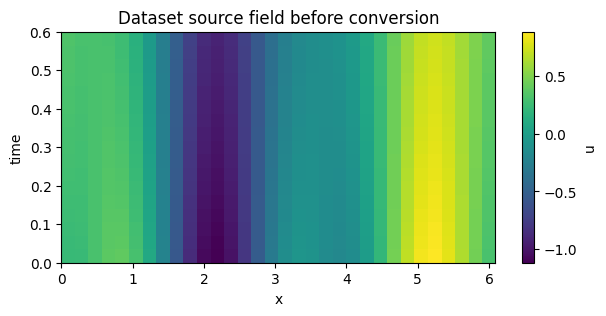
The Dataset has named coordinates and attrs. PDELie will report those clues, but canonical conversion still requires explicit metadata from the caller.
[2]:
source = generate_heat_1d_field_batch(**CONFIG)
metadata = deepcopy(source.metadata)
metadata["parameter_tags"] = dict(metadata["parameter_tags"])
metadata["parameter_tags"]["equation"] = "heat_1d"

dataset = xr.Dataset(
    data_vars={"u": (source.dims, source.values)},
    coords={name: values for name, values in source.coords.items()},
    attrs={"source": "tutorial_generated_heat", "note": "attrs are hints, not canonical metadata"},
)
print(dataset)
plot_field_heatmap(source, title="Dataset source field before conversion")
<xarray.Dataset> Size: 9kB
Dimensions:  (batch: 2, time: 17, x: 32, var: 1)
Coordinates:
  * time     (time) float64 136B 0.0 0.0375 0.075 0.1125 ... 0.525 0.5625 0.6
  * x        (x) float64 256B 0.0 0.1963 0.3927 0.589 ... 5.498 5.694 5.89 6.087
Dimensions without coordinates: batch, var
Data variables:
    u        (batch, time, x, var) float64 9kB 0.2347 0.2442 ... 2.525 2.385
Attributes:
    source:   tutorial_generated_heat
    note:     attrs are hints, not canonical metadata
2. Readiness first: a dashboard before conversion#
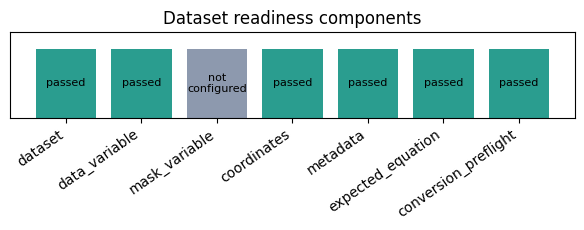
The readiness report is like an inspection station: data variable, coordinates, metadata, equation tag, and conversion preflight each get their own status.
[3]:
dataset_ready = summarize_xarray_dataset_readiness(
    dataset,
    metadata=metadata,
    expected_equation="heat_1d",
)
print(pretty_json({
    "readiness_label": dataset_ready["readiness_label"],
    "selected_data_var": dataset_ready["selected_data_var"],
    "candidate_variables": dataset_ready["candidate_variables"],
    "metadata_suggestions": dataset_ready["metadata_suggestions"],
}, max_chars=4500))
plot_component_statuses(dataset_ready, title="Dataset readiness components")
{
  "candidate_variables": [
    {
      "compatible": true,
      "dims": [
        "batch",
        "time",
        "x",
        "var"
      ],
      "dtype": "float64",
      "failures": [],
      "finite": true,
      "mask_candidate": false,
      "name": "u",
      "numeric": true,
      "shape": [
        2,
        17,
        32,
        1
      ]
    }
  ],
  "metadata_suggestions": {
    "boundary_conditions": {
      "x": "periodic"
    },
    "compatible_data_vars": [
      "u"
    ],
    "coordinate_system": "cartesian",
    "dataset_attr_keys": [
      "note",
      "source"
    ],
    "grid_regularity": "uniform",
    "grid_type": "rectilinear",
    "parameter_tags": {
      "domain_length": 6.283185307179586
    },
    "selected_data_var": "u"
  },
  "readiness_label": "ready",
  "selected_data_var": "u"
}
3. Convert exactly one scalar variable into a FieldBatch#
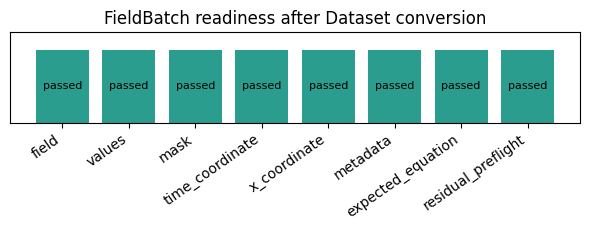
The conversion records a from_xarray_dataset preprocess step, then the existing from_xarray step. That provenance trail matters when your external data flow gets longer.
[4]:
imported = from_xarray_dataset(
    dataset,
    metadata=metadata,
    preprocess_log=[{"operation": "tutorial_dataset_build"}],
)
field_ready = summarize_field_batch_readiness(
    imported,
    residual_evaluator=HeatResidualEvaluator(),
    expected_equation="heat_1d",
)
direct = from_xarray(dataset["u"], metadata=metadata)
print(pretty_json({
    "field_snapshot": field_snapshot(imported),
    "field_readiness_label": field_ready["readiness_label"],
    "preprocess_operations": [entry["operation"] for entry in imported.preprocess_log],
    "matches_direct_dataarray_path": bool(np.allclose(imported.values, direct.values)),
}, max_chars=3500))
plot_component_statuses(field_ready, title="FieldBatch readiness after Dataset conversion")
{
  "field_readiness_label": "ready",
  "field_snapshot": {
    "dims": [
      "batch",
      "time",
      "x",
      "var"
    ],
    "mask_present": false,
    "metadata_parameter_tags": {
      "equation": "heat_1d",
      "nu": 0.1
    },
    "preprocess_steps": 3,
    "shape": [
      2,
      17,
      32,
      1
    ],
    "time_points": 17,
    "var_names": [
      "u"
    ],
    "x_points": 32
  },
  "matches_direct_dataarray_path": true,
  "preprocess_operations": [
    "tutorial_dataset_build",
    "from_xarray_dataset",
    "from_xarray"
  ]
}
4. Ambiguity is a feature, not a nuisance#
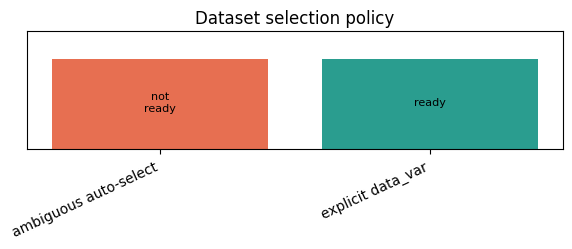
If a Dataset contains several compatible variables, PDELie refuses to guess. Choose data_var explicitly so the scientific target is visible in code review.
[5]:
ambiguous = dataset.assign(v=dataset["u"] * 0.5)
ambiguous_report = summarize_xarray_dataset_readiness(
    ambiguous,
    metadata=metadata,
    expected_equation="heat_1d",
)
explicit_report = summarize_xarray_dataset_readiness(
    ambiguous,
    data_var="u",
    metadata=metadata,
    expected_equation="heat_1d",
)
plot_label_strip(
    {
        "ambiguous auto-select": ambiguous_report["readiness_label"],
        "explicit data_var": explicit_report["readiness_label"],
    },
    title="Dataset selection policy",
)
print(pretty_json({
    "ambiguous_failures": ambiguous_report["component_statuses"]["data_variable"],
    "compatible_variables": [item["name"] for item in ambiguous_report["candidate_variables"] if item["compatible"]],
    "explicit_selected_data_var": explicit_report["selected_data_var"],
}, max_chars=3500))
{
  "ambiguous_failures": {
    "details": {
      "failures": [
        "ambiguous_data_var"
      ]
    },
    "reason": "dataset_data_var_not_ready",
    "status": "failed"
  },
  "compatible_variables": [
    "u",
    "v"
  ],
  "explicit_selected_data_var": "u"
}
Recap#
V0.29 gives you a narrow Dataset doorway: report first, select one scalar variable, supply explicit metadata, convert to canonical FieldBatch, then reuse the existing residual/readiness/confidence stack.
Common pitfalls#
Treating Dataset attrs as canonical metadata.
Expecting PDELie to pick between several compatible variables.
Passing endpoint-duplicated or nonuniform coordinates into spectral tools.
Reading files directly with PDELie; file loaders remain deferred.
Extension ideas#
Add a valid boolean mask variable and inspect how mask diagnostics change.
Compare Dataset readiness with and without
expected_equation.Use this notebook as the front door for your own xarray preprocessing script.
What to read/run next#
Run 08_downstream_task_template.ipynb to plug the imported FieldBatch into downstream contracts, or 00_pde_timeseries_to_generators.ipynb for the core generator-confidence flow.